
Updated 2026 "health stack" and future directions

INTRODUCTION
I am sure some people are wondering how does the “health stack” of an actual longevity scientist - a youngish male - look like. The end of 2025 is certainly a good time to take stock and review what we did and why. Below is an updated health protocol for 2026, which represents my current stack with very minor tweaks. But before we get into that, perhaps a few words about longevity science, blogging, health and the future of human progress.
First of all, a healthy diet and supplements won’t substantially affect aging. My hope is that, one day, humans will be able to stay young forever and cure aging so that people can choose their own fate. Fair is fair. If you share the same dream you should contribute to longevity science by donating to moonshot projects like Impetus grants or combinatorial mouse screening, founding or funding start-ups, or even becoming a researcher or policymaker.
Whether we are at all closer to this goal of radical lifespan extension remains debatable. There have been many breakthroughs during my lifetime, yet aging remains as formidable an enemy as ever. To name two, rapamycin showed that a drug can extend the lifespan of healthy mice even started in late middle age. GLP-1 receptor agonists showed that there is a way to both tackle the obesity pandemic, and test crude CR mimetics in humans, with mixed success so far. In fact, my hope was that the first approval of a real longevity drug, even if very primitive and impotent, would lead to an exponential increase in funding towards the development of new drugs. This has not happened so far.
However, talking of exponentials, we did see an explosive growth in AI investment and data center buildout. My current hope is that human-level artificial intelligence will be able to tackle many of the problems the field faces through sheer scale of intelligent brute force - imagine what we would find if we could screen a million drugs for lifespan extending effects in mice because labor, land and energy became cheap enough to allow this thanks to automation and AGI.
A healthy diet by itself will not get us to radical lifespan extension. That is why I remain committed to doing aging research, both translational science directed towards age-related disease, and basic science in the form of comparative biogerontology, and also in the form of lifespan studies in mice.
Nevertheless, I think that biohacking is important, albeit less so than frontier aging science. It fuels the ecosystem by injecting money into both research and relevant companies; it attracts new people; it is highly addictive; it enables research e.g. in the shape of observational studies of CRONies, rapamycin-users and health enthusiasts; and it DOES have small health benefits. Regarding health and biohacking my views can be summarized as “holistics”; drugs and supplements are often under-rated while exercise and diet are often overrated as drivers of health. Ultimately, all of them contribute and at this stage it is impossible to say which one is most important.
I have added some justifications but no references to this post, otherwise I would probably never get it published. You can trust me that these choices are sound in principle, and obviously, still highly imperfect. Do let me know if you have any suggestions.
Next blog article might be on taurine and then perhaps something more about frontier longevity research. Happy holidays!
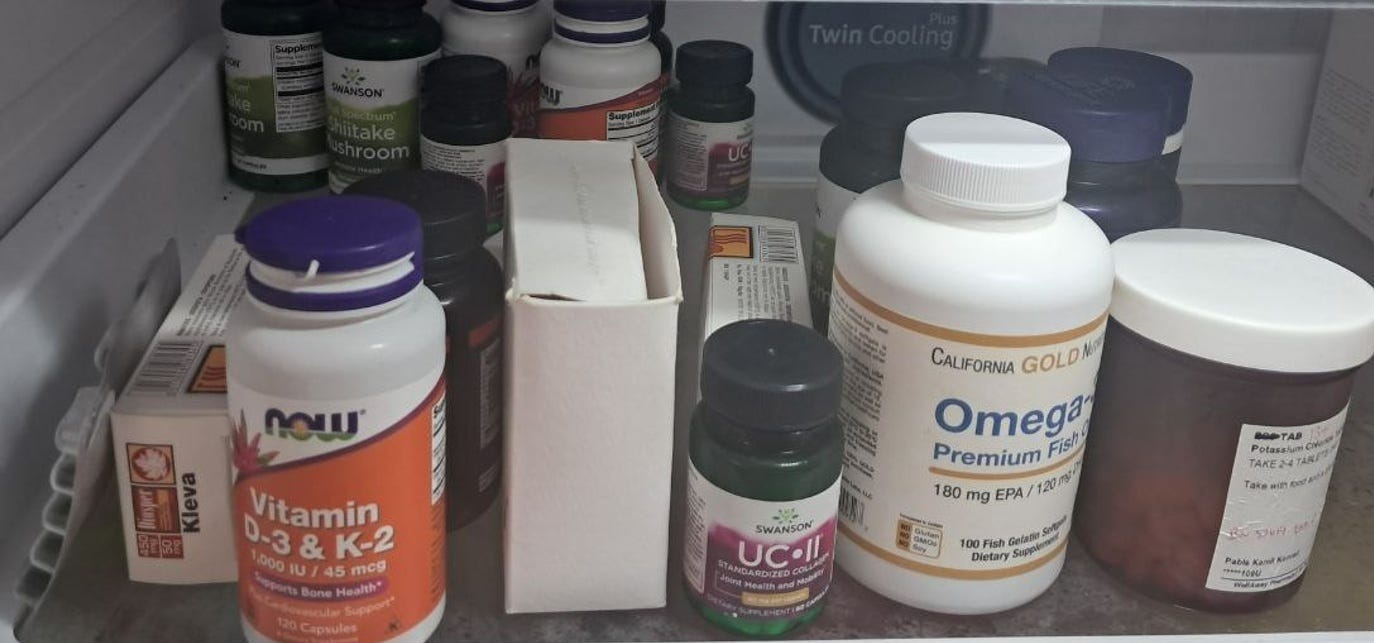
HEALTH STACK
Morning routine:
1. 10 mg sulforaphane (SFN) from Pprostaphane (after first meal of the day to reduce GIT irritation)
2. 250 mg cocoa polyphenols from CocoaVia
3. 180 mg EPA/ 120 mg DHA (1g of fish oil)
4. 1000 IU vitamin D, 45 mcg MK-4 (vitamin K2)
5. A cup of whey powder with extra cocoa and creatine mixed in cold oat milk.
6. Eye health. Always wear my glasses. In the morning, apply warm compresses, eye cleaning and eye drops for my iatrogenic dry eye disease.
7. Skin health. Then apply vitamin C, E, ferulic acid and niacinamide serum from my friends at Ikigai Medical (maybe they will give me the next batch for free if I say nice things about them!). Use a cheaper vitamin C serum on hands and neck. Wait at least a few minutes and then apply an SPF50 no-name sunblock.
Brief notes:
Most of the brands are no-name / standard brands that I trust. For some supplements the brand matters a lot and I will mention it as appropriate. For example, I use Prostaphane the only supplement on the market that has highly stabilized, active sulforaphane. I may or may not consider switching to myrosinase-release based SFN, not quite sold yet. (We have tested Prostaphane ourselves so we know it is legit, but testing the myrosinase release system is a bit harder.)
I use 250mg cocoa polyphenols from CocoaVia. I should use 500mg, but it is expensive. The 500mg dose reduces CVD mortality in the COSMOS trial.
I take fish oil because there is some evidence that it reduces CVD even in primary prevention but the data is weak and the benefits are offset by increased atrial fibrillation. Probably still slightly beneficial.
Vitamin D is essential if you are a creature of the night as I am. After seeing my vitamin D blood levels were a little too high for my liking, I cut down from 2000 IU to 1000 IU, although perhaps I should be taking 1500 IU. Weak evidence suggests that vitamin D can reduce cancer mortality and some other minor health benefits. Even weaker evidence suggests that vitamin K2 can reduce CAC progression.
I try to eat and drink as many cold beverages and foods as I can since there is strong evidence linking lower body temperatures with slower aging, while cold beverages lead to an acute body temperature lowering because they overwhelm temperature regulation. The taste is also fantastic! I use Optimum Nutrition Gold Standard Whey because most other wheys I tried are completely disgusting.
The dry eye protocol may not be relevant to normal people but it does seem important to point out that wearing specs is probably beneficial. Not only do glasses protect your eyes from dirt, which does contribute to inflammation and dry eye disease, which is a classical age-related disease, it also protects your eyes from UV radiation! (But do choose coated glasses.)
The CE Ferulic is the gold standard antioxidant mix that offers modest photoprotection, and niacinamide has some evidence for chemoprevention in the skin and a plausible mechanism of action (MOA). It goes without saying that everyone should wear SPF50, avoid the sun and use an umbrella during periods of high UV exposure.
Evening routine:
1. Shiitake supplement
2. 1000 mg Taurine
3. 40 mg UC-II for a total of 10mg collagen
4. 500 mg Mg Glycinate from my friends at Xandro Labs (100 mg Mg)
5. A cup of whey without extra cocoa and some collagen powder mixed in cold oat milk.
Brief notes: The Shiitake supplement is a hedge because I don’t get enough mushrooms from diet and there is some evidence for reduced mortality and improved cognitive function with either mushrooms or ergothioneine.
The taurine is for its blood pressure lowering, cardiometabolic and potential longevity benefits as demonstrated in humans and mice, respectively. Taurine might also be a source of H2S.
UC-II is because I have always had joint and soft tissue issues and the evidence is slightly better than for normal collagen with a more plausible MOA, but industry funding remains an issue. Magnesium is something I am trying out for fun since low Mg is harmful and unpublished studies show that Mg extends lifespan in mice.
Shortlist for future updates:
Low dose statin, intermittent rapamycin, algae supplement, double Cocovia, taurine and Prostaphane dose, increase vitamin D, etc.
Physical activity and lifestyle
Substantially more than 10k steps per day and 7.5 to 8hrs of sleep.
Gym 4-5 times per week. 3 sessions of cardio on an indoor bike and 3 sessions of strength. Also a strong focus on stretching, increasing ROM, rehab and thorough warm-up to fight my issues with repetetive strain inury (RSI).
Brief notes: I think indoor cycling or swimming are vastly superior for health outcomes to outdoor spoorts which ruin your skin and carry a higher risk of RSI. Exercise does not slow aging but it seems to have small cardiovascular (mortality) and larger cardiometabolic benefits. It is also important to walk regularly but I would take all quantitative recommendations for physical activity with a huge grain of salt due to substantial reverse causation.
When I have the time the first “lifestyle” intervention I will choose is not sauna, red light, HBOT or anything fancy, but it will be meditation, yoga or massage.
Diet
Morning: oats, frozen berries, oat bran, walnuts, mixed nut butter, apple slices, milk or yogurt
Lunch/dinner: Nothing special because I want to maximize my flexibility during the day. I usually eat outside, esp. Italian, Vietnamese, Turkish/Mediterranean/Arab, Indian, “bowls” and Western style in Singapore since these all offer very healthy meal choices. The focus is on getting salads, chicken, veggies and reduced, but nonzero, amounts of junk carbohydrates like rice. Three additional pieces of fruit during the day.
Evening: hummus with vegetables
Brief notes: I used to be very skinny, perhaps similar to someone who does mild caloric restriction, but for aesthetic reasons I have recently decided to bulk up. I still think that being super slim and doing CR is likely a net benefit but with the advent of rapamycin going the route of gym + intermittent mTOR suppression seems like a similarly evidence-based bet.
Biomarkers and health outcomes
Not much to say before this post gets too long. I like to monitor the biomarkers underlying the LinAge2 clock that my colleagues at NUS developed.
Weight gain, stress, high salt consumption and bad diet lead to mild hypertension when I first started bulking, which I got under control with a stricter diet, cardio and blood pressure lowering supplements. Last year, finally, I was on track to have decently good biomarkers with e.g. BP of <120/80 mmHg at a heart rate of 60 bpm, with decently low LDL, Lp(a), ferritin, CRP, etc. (Then I had an injury and had to skip 2months+ of cardio.)
Mental health
At least 10min of Anki, DNS and app-based blocks on addictive webpages, grey-screen for social media apps
Therapy/coaching twice per month to fight akrasia, anhedonia and mild depression.
Brief notes:
I have high hopes for Anki. Not only is it great for language learning, but I also want to trial it as a tool to fight akrasia by developing microhabits. I think 30 mins of anki per day might be sustainable for me. It is also very likely beneficial to prevent memory loss and MCI, albeit obviously not a causal treatment.
Oral health
Brush 3x per day, use an electric toothbrush in the morning and evening, floss in the evening, alcohol free mouthwash after the floss.
Hair
Nizoral shampoo applied for 5 minutes Mon, Wed, Sat. Apply shampoo then proceed to brush teeth or shave. Will restart low dose finasteride with minoxidil if my dry eye symptoms improve, because finasteride use is linked with dry eye and even the topical fina appears to make my symptoms worse.
References
(Experimentally generated with GPT-5.2. thinking. Around 80% are solid references I would have cited myself.)
ASCEND Study Collaborative Group. (2018). Effects of n−3 fatty acid supplements in diabetes mellitus. The New England Journal of Medicine, 379(16), 1540–1550. https://doi.org/10.1056/NEJMoa1804989
Ba, D. M., Gao, X., Muscat, J., Al-Shaar, L., Chinchilli, V. M., Zhang, X., Ssentongo, P., Beelman, R. B., & Richie, J. P., Jr. (2021). Association of mushroom consumption with all-cause and cause-specific mortality among American adults: prospective cohort study findings from NHANES III. Nutrition Journal, 20(1), 38. https://doi.org/10.1186/s12937-021-00691-8
Bagheri, A., Naghshi, S., Sadeghi, O., Larijani, B., & Esmaillzadeh, A. (2021). Total, dietary, and supplemental magnesium intakes and risk of all-cause, cardiovascular, and cancer mortality: A systematic review and dose–response meta-analysis of prospective cohort studies. Advances in Nutrition. https://doi.org/10.1093/advances/nmab001
Chen, A. C., Martin, A. J., Choy, B., Fernández-Peñas, P., Dalziell, R. A., McKenzie, C. A., Scolyer, R. A., Dhillon, H. M., Vardy, J. L., Kricker, A., Armstrong, B. K., & Damian, D. L. (2015). A phase 3 randomized trial of nicotinamide for skin-cancer chemoprevention. The New England Journal of Medicine, 373(17), 1618–1626. https://doi.org/10.1056/NEJMoa1506197
Cipolla, B. G., Mandron, E., Lefort, J.-M., Coadou, Y., Della Negra, E., Corbel, L., Le Scodan, R., Azzouzi, A.-R., & Mottet, N. (2015). Effect of sulforaphane in men with biochemical recurrence after radical prostatectomy. Cancer Prevention Research, 8(8), 712–719. https://doi.org/10.1158/1940-6207.CAPR-14-0459
Conti, B., Sanchez-Alavez, M., Winsky-Sommerer, R., Morale, M. C., Lucero, J., Brownell, S., Fabre, V., Huitron-Resendiz, S., Henriksen, S., Zorrilla, E. P., de Lecea, L., & Bartfai, T. (2006). Transgenic mice with a reduced core body temperature have an increased life span. Science, 314(5800), 825–828. https://doi.org/10.1126/science.1132191
Crowley, D. C., Lau, F. C., Sharma, P., Evans, M., Guthrie, N., Bagchi, M., Bagchi, D., Dey, D. K., & Raychaudhuri, S. P. (2009). Safety and efficacy of undenatured type II collagen in the treatment of osteoarthritis of the knee: a clinical trial. International Journal of Medical Sciences, 6(6), 312–321. https://doi.org/10.7150/ijms.6.312
Fahey, J. W., et al. (2017). Stabilized sulforaphane for clinical use: Phytochemical delivery efficiency. Molecular Nutrition & Food Research. https://doi.org/10.1002/mnfr.201600766
Fong, S., et al. (2025). LinAge2: providing actionable insights and benchmarking with epigenetic clocks. npj Aging. https://doi.org/10.1038/s41514-025-00221-4
Gencer, B., et al. (2021). Effect of long-term marine ω-3 fatty acids supplementation on the risk of atrial fibrillation in randomized controlled trials of cardiovascular outcomes: A systematic review and meta-analysis. Circulation. https://doi.org/10.1161/CIRCULATIONAHA.121.055654
Guan, L., et al. (2020). The effects of taurine supplementation on obesity, blood pressure and lipid profile: A meta-analysis of randomized controlled trials. European Journal of Pharmacology, 885, 173533. https://doi.org/10.1016/j.ejphar.2020.173533
Harrison, D. E., et al. (2009). Rapamycin fed late in life extends lifespan in genetically heterogeneous mice. Nature, 460(7253), 392–395. https://doi.org/10.1038/nature08221
Hasific, S., et al. (2023). Effects of vitamin K2 and D supplementation on coronary artery disease in men: A RCT. JACC: Advances, 2(9), 100643. https://doi.org/10.1016/j.jacadv.2023.100643
Houghton, C. A. (2019). Sulforaphane: Its “coming of age” as a clinically relevant nutraceutical in the prevention and treatment of chronic disease. Oxidative Medicine and Cellular Longevity, 2019, 2716870. https://doi.org/10.1155/2019/2716870
Keum, N., Lee, D. H., Greenwood, D. C., Manson, J. E., & Giovannucci, E. (2019). Vitamin D supplementation and total cancer incidence and mortality: a meta-analysis of randomized controlled trials. Annals of Oncology, 30(5), 733–743. https://doi.org/10.1093/annonc/mdz059
Lincoff, A. M., et al. (2023). Semaglutide and cardiovascular outcomes in obesity without diabetes. The New England Journal of Medicine, 389(24), 2221–2232. https://doi.org/10.1056/NEJMoa2307563
Lugo, J. P., et al. (2013). Undenatured type II collagen (UC-II®) for joint support: a randomized, double-blind, placebo-controlled study in healthy volunteers. Journal of the International Society of Sports Nutrition, 10, 48. https://doi.org/10.1186/1550-2783-10-48
Manson, J. E., et al. (2019). Marine n−3 fatty acids and prevention of cardiovascular disease and cancer. The New England Journal of Medicine, 380(1), 23–32. https://doi.org/10.1056/NEJMoa1811403
Manson, J. E., et al. (2019). Vitamin D supplements and prevention of cancer and cardiovascular disease. The New England Journal of Medicine, 380(1), 33–44. https://doi.org/10.1056/NEJMoa1809944
Sesso, H. D., et al. (2022). Effect of cocoa flavanol supplementation for the prevention of cardiovascular disease events: the COcoa Supplement and Multivitamin Outcomes Study (COSMOS) randomized clinical trial. The American Journal of Clinical Nutrition, 115(6), 1490–1500. https://doi.org/10.1093/ajcn/nqac055
Singh, P., et al. (2023). Taurine deficiency as a driver of aging. Science, 380(6649), eabn9257. https://doi.org/10.1126/science.abn9257
Smith, E., Ottosson, F., Hellstrand, S., Ericson, U., Orho-Melander, M., Fernandez, C., & Melander, O. (2020). Ergothioneine is associated with reduced mortality and decreased risk of cardiovascular disease. Heart, 106(9), 691–697. https://doi.org/10.1136/heartjnl-2019-315485
Sun, Q., et al. (2016). Taurine supplementation lowers blood pressure and improves vascular function in prehypertension: randomized, double-blind, placebo-controlled study. Hypertension, 67(3), 541–549. https://doi.org/10.1161/HYPERTENSIONAHA.115.06624
Vetter, V. M., Sommerer, Y., Kalies, C. H., Spira, D., Bertram, L., & Demuth, I. (2022). Vitamin D supplementation is associated with slower epigenetic aging. GeroScience, 44(3), 1847–1859. https://doi.org/10.1007/s11357-022-00581-9
Villa-Bellosta, R., et al. (2020). Dietary magnesium supplementation improves lifespan in a mouse model of progeria. EMBO Molecular Medicine. https://doi.org/10.15252/emmm.202012423
Wilding, J. P. H., et al. (2021). Once-weekly semaglutide in adults with overweight or obesity. The New England Journal of Medicine, 384(11), 989–1002. https://doi.org/10.1056/NEJMoa2032183
Zwakenberg, S. R., et al. (2019). The effect of menaquinone-7 supplementation on vascular calcification in patients with diabetes: a randomized, double-blind, placebo-controlled trial. The American Journal of Clinical Nutrition, 883–890. https://doi.org/10.1093/ajcn/nqz147
Do you use Anki for language-learning only, or does "developing microhabits" also refer to mantras/daily affirmations?